


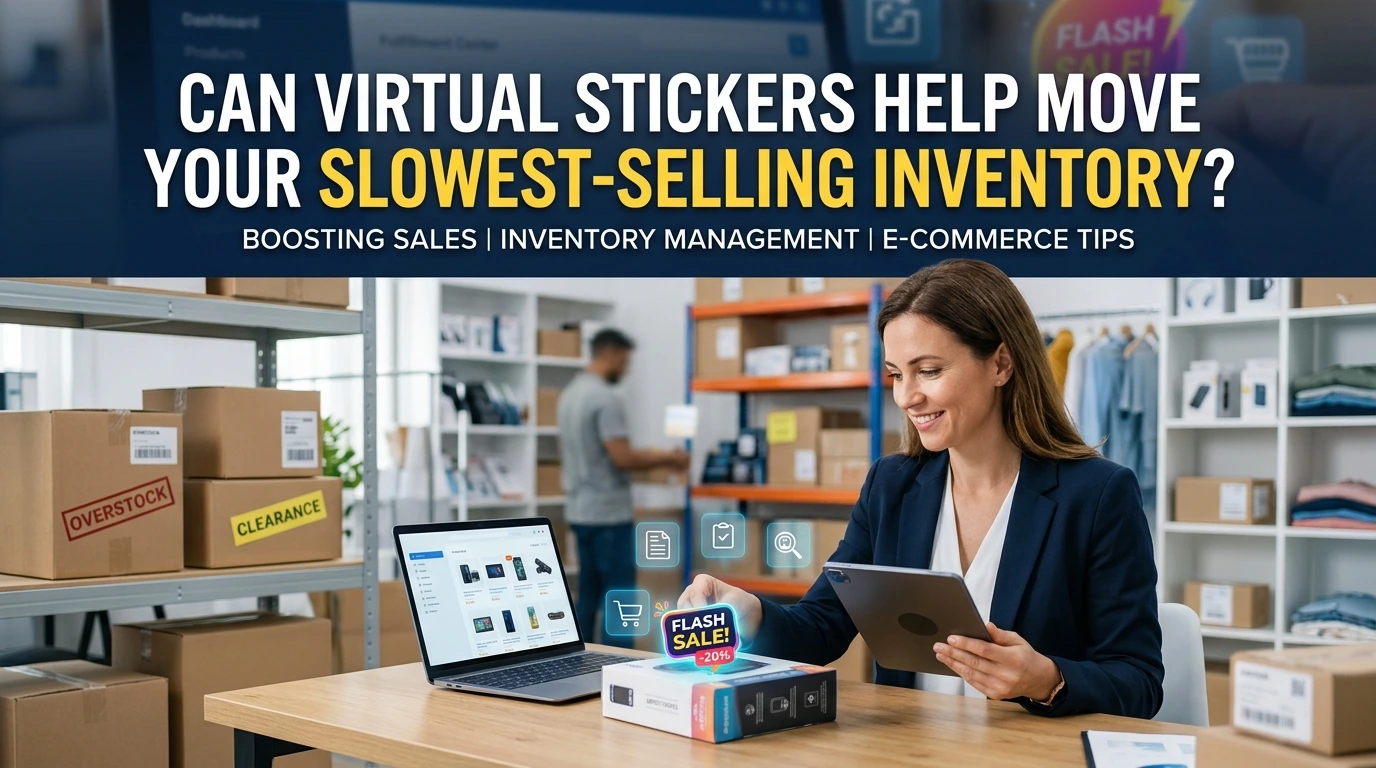
Sitting on dead stock drains your capital and takes up valuable shelf space, but constant price markdowns can erode your brand value. Virtual stickers offer a fresh, dynamic way to draw eyes to slow-moving products without triggering a race to the bottom.
By adding subtle visual cues like "Trending," "Low Stock," or "Exclusive" directly to your product images, you tap into proven buyer psychology. These subtle badges create instant urgency and trust, converting forgotten inventory into your next big sales driver.
Why Deep Discounts Are A Trap For Slow-moving Stock
Virtual stickers are digital badges or labels applied to product listings to highlight urgency, scarcity, or special status, such as "Last few left" or "Exclusive deal", without changing the price. They move slow-selling inventory by boosting click-through and conversion rates through psychological triggers, often outperforming discounts while protecting your margins. For PrestaShop merchants, they are the cheapest lever you have: a message change at the display layer rather than a permanent cut to the price you can charge tomorrow.
Think about the last time you slashed a product that had been sitting in a PrestaShop category for months. The orders came in, but so did a queue of customers who now expect that price on everything else you sell. Discounting is the fastest way to clear stock and the slowest way to build a brand customers trust to hold its value.
The arithmetic is unforgiving. Industry data shows dead stock accounts for an average of 12% of total capital tied up in small retail shops, and every percentage point of margin you give away to shift it is money you cannot spend on restocking winners. A price cut is permanent in the customer's memory; a badge can be removed tomorrow.
Discounts train customers to wait; virtual stickers train them to act.
On PrestaShop, this matters because product listings, category grids and product pages are all template-driven. A badge is applied at the display layer, so you can label slow movers without editing a single price rule or touching your tax and cart logic. Merchandising becomes a lever you pull, not a markdown you regret.
- Your reference price stays honest, so future full-price sales are easier to run.
- You can target individual products or whole categories instead of a blanket sale.
- You keep the option to swap the message weekly as stock levels shift.
Where stickers alone are not enough, pair them with intelligent product placement rather than deeper cuts. The PrestaShop AI Cross Selling & Upsell Recommendations module (priced at $59.00) surfaces related and higher-value items next to the stock you are trying to shift, using built-in AI that draws on trends, views, ratings, categories, brands and purchase history with no external paid service required.
What are Virtual Stickers and How Do They Work?
A virtual sticker is a text or graphic badge overlaid on a product image, listing entry or product page, rather than stuck to physical packaging. In PrestaShop terms it is closest to a combination of the "On sale" flag and labels except you control the wording, the colour, the position and the timing. You are not reducing the price; you are adding context to it.
That distinction matters more than it sounds. A discount speaks only about money. A sticker speaks about the product's place in your catalogue: how few remain, how quickly it is moving, which type of customer already bought it.
Three psychological mechanisms do the heavy lifting:
- Urgency pushes the customer to decide now rather than bookmark the page. "Final 4 in this colour" or "Clearance ends Sunday" works because the deadline is real and visible.
- Scarcity raises perceived value by making supply feel finite. "Last one in size 42" tells a shopper that waiting carries risk.
- Social proof removes doubt. A line such as "Best seller in leather goods" reassures a hesitant buyer that other people already made the same choice.
Placement is where most merchants get it wrong. A sticker buried below the fold does nothing. In PrestaShop, the highest-performing positions are the product thumbnail in category grids, the top-left corner of the product page image, and the cart summary where a "low stock, add matching items" nudge can still change the order.
The practical rule: a virtual sticker should add information the page does not already show. If it repeats the price tag, it is decoration. If it explains why the price is low, or why the customer should act, it converts.
Virtual Stickers vs Discounts: Which Clears Dead Stock Faster?
Discounts move units faster in the short term, but virtual stickers protect the margin you keep. That trade-off defines which tactic you should reach for, because the goal is not just an empty shelf, it is clearing stock without gutting your profit.
Price cuts work by lowering the barrier to purchase. A customer who was hesitating at full price may convert at a lower one. But every percentage point you shave comes straight off your margin, and a product that already sat unsold rarely had a pricing problem alone. It had a visibility or desire problem, and a discount does nothing to fix either.
A virtual sticker changes the framing instead of the number. It adds a reason to act now, a badge, a bundle flag, a limited-run callout, without touching the base price. That preserves the item's value in the customer's mind and keeps your margin intact. If the item still does not sell, you can layer a modest discount on top later, having lost nothing by trying the sticker first.
Compare the two honestly:
| Aspect | Blanket discount | Virtual sticker |
|---|---|---|
| Conversion impact | Immediate and strong for price-sensitive buyers | Moderate, relies on urgency and perceived value |
| Margin impact | Direct and permanent on every unit sold | None on price; cost sits in merchandising effort |
| Brand perception | Can train customers to wait for the next sale | Reads as curated and intentional |
The temptation is always to jump straight to the biggest lever. But deep discounting is a blunt instrument, and some retailers run clearance markdowns of 60-75% off to shift the last of their dead stock, according to a renowned wholesale seller. Use stickers first to build urgency and surface slow sellers, and reserve genuine markdowns for stock that still refuses to move. To push related items alongside a flagged product, the PrestaShop AI Cross Selling & Upsell Recommendations module places cross-sell and upsell suggestions on key pages, so a sticker can point shoppers toward a profitable pair rather than a price cut.
How To Implement Virtual Stickers in PrestaShop Step By Step
PrestaShop gives you a native hook for exactly this job: the product flags on the Product Details tab, under Options. You can apply a sticker manually on a single product, or run one across a whole category, and the approach changes how much control you keep.
Option 1: Native Product Flags (no module, full manual control)
- Open Catalog > Products and select the slow-moving item.
- Go to the Product Details tab, find Options and enable Available for order.
- Tick the New flag in the same block, then open the Specific Prices section to attach a start and end date to any price change you want the sticker to sit alongside.
The catch is flexibility. PrestaShop's built-in flags are fixed labels, so you get "New" or "On sale", not "Last 20 units in Navy". That is fine for a quick test on one product, but it becomes repetitive if you are stickering a hundred references.
Option 2: A Module That Manages Badges at Scale
For category-wide rollouts, a module is the realistic route. Keep the sticker logic and the recommendation logic separate: use a merchandising or badge module to render the visual label, and hand the "what should the customer look at next" job to PrestaShop AI Cross Selling & Upsell Recommendations at $59.00, which surfaces suggestions based on views, ratings, categories, brands and purchase history without an external paid service. The sticker creates the pull; the recommendations make the visit count for more than one product.
What To Decide Before You Build Them
- Placement: product image (most visible), product listing grid (widest reach), or product page only (lowest risk of clutter).
- Copy: one short scarcity or status line, never a percentage.
- Duration: tie every sticker to an expiry date so it can be removed automatically.
- Audience: hide aggressive scarcity labels from logged-in trade accounts where they undermine negotiated pricing.
Before switching anything live, duplicate one product and test the sticker at each viewport. Test the Product Listing page and the Product page separately, because themes often place badge overlays differently between the two, and a label that sits correctly in the grid can overlap the price block on the detail view.
Which Virtual Stickers Work Best for Different Slow-moving Products?
There is no universal sticker. A message that shifts a dusty spare part will fall flat on a premium handbag, and a scarcity badge on an outdated accessory just looks odd. Match the sticker type to why the product stalled and who is buying it.
| Sticker type | Best suited to | Customer motivation it taps |
|---|---|---|
| Urgency ("Last few days") | Seasonal lines, dated packaging, anything with a calendar deadline | Fear of missing the window, not fear of missing the product |
| Scarcity ("Only 3 left") | Genuinely low-stock sizes, colours or variants | Loss aversion, the sense the decision is being made for them |
| Exclusivity ("Members only") | Higher-ticket or brand-sensitive goods where a discount would cheapen the line | Status and belonging, which protects the price point |
| Value framing ("Buy 2, save") | Low-cost accessories, consumables, add-on items | Getting more for the same spend, which lifts basket size |
Price point is the quickest filter. On low-cost items, shoppers respond to value framing and scarcity because the decision is fast and low-risk. At premium price points, urgency and value framing start to signal desperation, so lead with exclusivity or a bundled offer instead.
Category behaviour matters too. Fashion and homeware carry emotional weight, so scarcity and exclusivity read as curation rather than clearance. Functional goods, such as tools, cables, printer ink or replacement parts, respond better to value framing and urgency, because buyers are solving a problem and comparing cost.
The sticker should explain why the price is what it is, not just shout that it is lower. "Ex-display, one only" justifies a markdown without suggesting the product was never worth its original price.
When a product has related items sitting nearby, a recommendation block can carry the value message instead of a badge.
Do Virtual Stickers Actually Help Clear Slow-selling Inventory?
There is no universal uplift figure, and anyone quoting one for your catalogue is guessing. What can be said with confidence is that virtual stickers change shopper behaviour in ways that matter for aged stock: they interrupt the scan pattern, they answer the "why is this still here?" question before the customer asks it, and they justify attention without touching the margin on the item itself.
A sweater sitting unbought for months is invisible, not disliked. A sticker that reads "Last 4 in stock" or "Final run" converts it from background noise into a decision. Merchants who run this tactic usually report the same pattern: clicks rise first, conversions follow soon after going live. That is a behavioural shift, not a price incentive, which is exactly the point.
Where it goes wrong:
- Stickers applied to everything lose all meaning. If half your grid shouts, nothing shouts.
- Claims that are not true destroy trust fast. "Only 2 left" on a product you can reorder indefinitely is a refund request waiting to happen.
- Stickers used as a permanent fixture stop feeling urgent. Rotate them, or set an expiry and honour it.
- Labels that clash with your theme make the whole storefront look cheap, which costs more than the discount you avoided.
One practical lever sits alongside stickers rather than replacing them. Prestashop AI Cross Selling & Upsell Recommendations surfaces related products on product pages using trends, views, ratings, categories, brands and purchase history, so a customer landing on a slow mover is shown something they may actually want. Combining a visible sticker on the slow item with an intelligent recommendation beside it often moves the pair together.
A sticker does not lower your price; it raises your product's visibility, and that is a far cheaper way to move stock.
Common Mistakes to Avoid When Using Virtual Stickers
Virtual stickers reward restraint. The tactic works because a single well-placed badge interrupts the scroll and signals a reason to buy now. Break that focus, and the badge stops meaning anything.
- Sticker overload. Two or three badges on one product tile (NewSaleLimitedBestseller) cancel each other out. The eye skips the whole block. Fewer stickers, sharper message.
- Vague wording. "Hot deal" tells the shopper nothing. "Only a handful left" or "Restocked once" gives them a concrete reason to decide today.
- Stickers that never expire. An urgency badge that sits unchanged for months trains repeat visitors to ignore it. Rotate the messaging or pull it when the trigger no longer applies.
- Covering the product. A badge that hides the item's shape, colour or label pushes people away. Position it over empty space in the image.
- Contrast failures. A pale badge on a pale photo disappears, and a bright badge on a busy lifestyle shot becomes noise. Test on mobile, where tiles are small.
- Claims you cannot back. "Almost gone" when you hold hundreds of units is a trust problem, not a tactic. Shoppers compare notes, and returning customers notice.
- Sticker-only fatigue. If every slow mover wears the same badge, nothing feels special. Pair the sticker with relevant cross-sells so the page still adds value, which is where Prestashop AI Cross Selling & Upsell Recommendations earns its keep by surfacing items shoppers actually want alongside the discounted line.
Treat the sticker as a spotlight, not wallpaper. One clear signal per product beats four competing ones every time.
Your Next Step: Test Virtual Stickers on Your Slowest Movers
Pick one slow-moving category, not your whole catalogue. Choose ten to twenty products with the worst turnover, then split them into two comparable groups. Leave group A untouched so you keep a clean control. Apply a virtual sticker to group B only, and resist editing anything else on those product pages during the test.
Run the test for three to four weeks. That is long enough to gather meaningful sessions without letting seasonal traffic muddy the result.
Track two numbers per group: conversion rate and sell-through. PrestaShop's Stats dashboard covers the first through Orders and Visits while product-level sell-through comes from exporting your catalogue under Advanced Parameters. Compare units sold against starting stock for both groups.
- Sessions and conversion rate per product page
- Units sold during the test window
- Remaining stock at the end of the period
- Margin per sale, so a higher conversion rate on thinner profit still gets caught
If group B clears more units at a healthy margin, roll the sticker pattern out to similar categories. If it does nothing, the sticker is not the problem: the product likely needs better demand context. A recommendation engine can surface those slow movers inside the baskets of shoppers already buying something related. Prestashop AI Cross Selling & Upsell Recommendations does this from $59.00, using its built-in AI to place suggestions based on trends, views, ratings, categories, brands and purchase history.
What Virtual Stickers Actually Do for Slow-Moving Stock
Virtual stickers are visual badges, ribbons and labels overlaid on a product image or listing that communicate value, scarcity or status without changing the price. For PrestaShop merchants sitting on slow-selling stock, they solve a specific problem: how to move units without slashing margin on everything else in the catalogue.
A blanket discount trains customers to wait for the next sale and devalues the products you discount. A well-placed sticker creates perceived value and urgency instead, nudging the shopper toward a decision while your pricing stays intact. This guide covers where to place them, how to word them, and how to combine them with recommendation logic so the slow movers actually get seen.
Why A Sticker Beats A Blanket Discount
Discounting is the default response to dead stock, and it works, but it is expensive. Research on dead stock strategies notes that tiered clearance typically starts with a moderate discount in the region of 20-30% off before escalating, and heavier phases push far deeper. Every one of those percentage points comes straight out of your margin.
Once you halve a product's price, you need to sell roughly twice the volume just to recover the same revenue, and slow movers are slow precisely because they are not selling in volume. A sticker changes the framing of the offer rather than the price itself, so the customer perceives a reason to act now.
A sticker costs you nothing per unit sold; a discount costs you margin on every single one.
That distinction matters most when the product is genuinely good but simply invisible. If the item is buried deep in a category, the fix is visibility, not price. Stickers are a visibility tool first and a persuasion tool second.
Where to Place Virtual Stickers in PrestaShop
Placement follows the customer's eye path through a PrestaShop store. Put a sticker where the shopper is already looking, not in a corner nobody scans.
- Product thumbnails in category and listing pages: This is where most browsing decisions happen. A sticker here earns the click that gets the product into the product page at all.
- The main product image on the product page: Reinforce the same message the thumbnail promised, so the shopper does not feel misled by the time they arrive.
- Product titles or short descriptions: A small inline label next to the name works well for status messages such as a restock notice.
- Cart and cross-sell blocks: Use a sticker to flag a slow mover being recommended alongside a popular item, which gives the suggestion a reason to exist.
Consistency is what separates a merchandising tactic from a gimmick. If a shopper sees "Last few" on a thumbnail, the product page should not read "In stock" with no acknowledgement. Keep the wording and colour meaning identical across every placement.
Sticker Types That Create Urgency Without Panic
The wording you choose determines whether a sticker reads as helpful or desperate. Match the message to a real condition in your PrestaShop catalogue, or shoppers will stop trusting the labels entirely.
Scarcity and Stock-level Stickers
Use these only when the stock figure genuinely supports it, such as a low-quantity alert that pulls from your real inventory count. A permanent "Only 2 left" badge on a product you have hundreds of destroys credibility across the whole store.
Freshness and Newness Stickers
Newly listed or recently restocked items benefit from a small label that draws the eye. This is useful for products you have just moved to a more prominent category position, because it explains to a returning customer why they are seeing something unfamiliar.
Value and Bundle Stickers
Labels such as "Buy 2 save more" or "Complete the set" work well on accessories and complementary items. This is where sticker merchandising overlaps naturally with bundling.
Curated and Staff-pick Stickers
A simple "Staff pick" or "Customer favourite" badge, applied honestly and sparingly, borrows social proof without needing a review widget. Rotate them so the same three products are not permanently flagged.
Pairing Stickers with Recommendation Logic
Stickers make a product look interesting. Recommendations make sure it gets seen in the first place, and the two work better together than either does alone. This is where an AI recommendation engine earns its place in the merchandising stack.
PrestaShop AI Cross Selling & Upsell Recommendations is a PrestaShop module that displays cross-sell and upsell items across key pages using a built-in AI engine, with no third-party accounts or paid services required. It also includes ChatGPT and Gemini integration. Because the recommendations draw on trends, views, ratings, categories, brands and customer purchase history, a slow-moving product can surface next to a bestseller where a sticker then does the persuading.
The practical workflow is straightforward. Let the module identify which slow movers genuinely pair with high-traffic products, then apply stickers to that shortlist. You are not guessing which items to promote; you are flagging the ones the recommendation engine has already identified as relevant.
A Practical Rollout for a PrestaShop Catalogue
Start narrow. Pick one slow-moving category, apply the steps below, and measure before expanding to the rest of the store.
- Filter your PrestaShop catalogue by products with high stock levels and low sales velocity over the last few months.
- Split that list into two groups: items that pair well with bestsellers, and items that stand alone.
- Apply a scarcity or freshness sticker to the standalone items, using wording that reflects the real situation.
- Enable cross-sell and upsell recommendations so the pairable items appear alongside the bestsellers they complement.
- Apply a value or staff-pick sticker to those recommended items so the suggestion carries a reason to click.
- Review performance after a few weeks and rotate your stickers.
Verdict: Do Virtual Stickers Earn their Place in Your PrestaShop Store?
Virtual stickers are not a magic wand, but they are the cheapest hedging tool in your merchandising kit. They let you test whether a slow mover is invisible or genuinely unwanted, and they do it without writing down a single price. If a badge lifts clicks and conversions, you have cleared stock at full margin. If it does not, you have learned that the product needs a different home in the catalogue, and you have lost nothing but an afternoon of copywriting.
What makes them work in practice is discipline: real claims, a real expiry date, one badge per tile, and a clear sense of which products deserve the spotlight. Where stickers alone run out of road, pair them with a recommendation engine so the slow mover gets surfaced next to products people are already buying. Visibility plus context moves more stock than a price cut ever will.
If your catalogue has category pages full of products nobody clicks, the fix is not another sale. Install Prestashop AI Cross Selling & Upsell Recommendations for $59.00, pick one slow category, flag ten products with honest badges, and give the next four weeks a chance to prove which levers actually shift your stock.