



Choosing the right ecommerce platform is one of the most important decisions for building long-term organic traffic. Different shopping carts offer very different levels of SEO control, affecting how well your store ranks on Google, how fast your pages load, and how easily you can optimize product and category pages for search visibility.
In this analysis, we compare the most widely used ecommerce platforms: Shopify, WooCommerce, Magento, OpenCart, and PrestaShop. Each is evaluated based on real SEO performance factors such as URL structure, technical SEO control, page speed, content flexibility, and scalability.
What Defines the Best Shopping Cart for SEO?
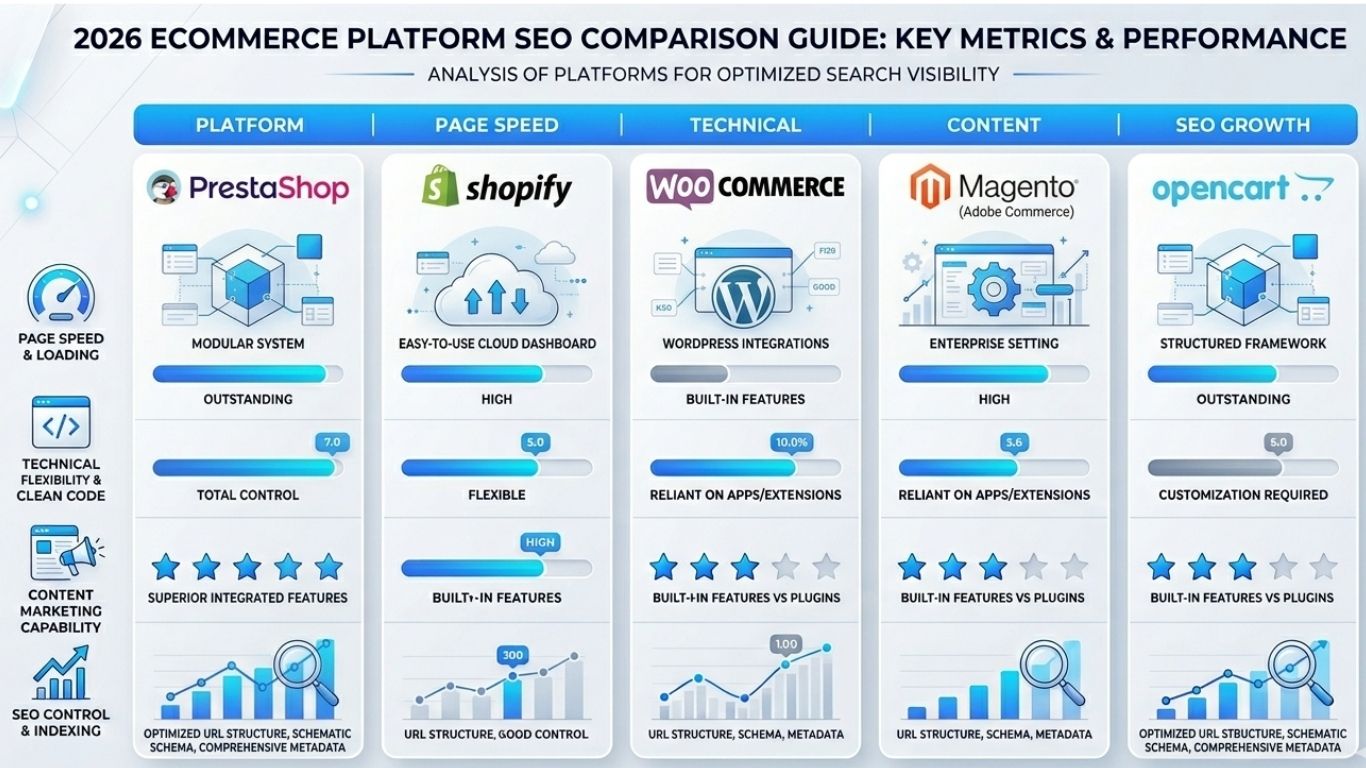
Before comparing platforms, it is important to understand what actually makes a shopping cart SEO-friendly.
A good ecommerce platform should allow full control over URL structures so you can create clean, keyword-rich links instead of system-generated ones. It should also make it easy to edit meta titles and descriptions, which directly impact click-through rates in search results. Like when you are on PrestaShop, you can easily add the Pretty URL module, which takes care of everything.
Another key ranking factor is page speed, especially on mobile devices, where fast load times significantly impact both user experience and search rankings. In addition, strong technical SEO capabilities are essential, including control over canonical tags, robots.txt configuration, XML sitemap generation, and structured data implementation to support rich snippets in search results.
Lastly, the platform needs to include content marketing from blogs and landing pages, informational content is one of the biggest sources of organic traffic for risky ecommerce niches.
SEO Comparison Factors (Quick Overview)
- URL Structure control.
- Page speed and Core Web Vitals performance.
- Metadata and schema flexibility.
- Content marketing capabilities.
- Technical SEO access (robots.txt, canonical tags, indexing rules).
- Scalability for large product catalogs.
4 Best Shopping Cart for SEO in 2026
Here’s the list of the 4 best shopping carts for seo merchants can look into in 2026.
Shopify: Easy, but Not Very Flexible for SEO
One of the most used ecommerce platforms is Shopify due to its easy to use and managed hosting environment. It runs quickly, is mobile-optimized, and provides basic SEO features from the start, including editable meta tags and automatic creation of a sitemap.
On the other hand, with advanced SEO control Shopify leaves a lot to be desired. The URL structure is not flexible and contains unused folders like “/products/” and “/collections,” which are not customizable. This lowers keyword optimization opportunity for SEO professionals aiming at clean, high-ranking URL structures.
Deep technical SEO access is also limited on Shopify, which can be a turn-off for businesses that rely heavily on advanced optimizations.
Shopify is a strong choice for beginners who want simplicity and reliable performance, but it becomes limiting for advanced SEO strategies that require deep control over URL structure, internal linking, and technical optimization.
WooCommerce: Strong for Content-Driven SEO
WooCommerce, built on WordPress, is one of the strongest ecommerce platforms for content-driven SEO strategies. Using WooCommerce brings many benefits such as powerful blogging features and extensive plugin support for SEO.
It offers complete control over URL structures, metadata, schema markup and internal linking strategies. For businesses that are focused on targeting long-tail keywords and gaining organic traffic from content, this can be really useful.
However, WooCommerce depends heavily on hosting quality and plugins, which means performance and SEO can suffer if the site is not properly optimized. Misconfiguration may slow down your website, causing an adverse effect on SEO ranking. Also, the self-hosted ones require more technical maintenance than hosted platforms.
For long-term performance, a core strength of WooCommerce is its value in SEO-driven content strategies, which can help you rank higher and sell more over time, but it requires ongoing optimization to keep it up!
Magento: Enterprise-Level SEO Power

Magento is a powerful enterprise-level ecommerce solution designed for large-scale businesses. It enables extensive SEO technical customization, URL rewrites, layered navigation indexing options, and it has high-level schema integration.
At the same time, it enables multi-store SEO strategies, which means that a single website can target multiple regions and languages for international ecommerce.
The downside is complexity. Magento has large amounts of development resources and server requirements. It is resource-demanding and not something a small or mid-level enterprise looking for rapid deployment could accomplish.
SEO is wonderfully strong in Magento, but generally too difficult and pricey to the majority of ecommerce merchants.
OpenCart: Easy & Light but Lacks Branded SEO Features
OpenCart is a relatively light ecommerce solution and is easy to install/manage. It offers some basic SEO features: customizable meta tags, SEO-friendly URLs, and rudimentary extensions for more advanced optimization.
That being said, OpenCart does not have advanced SEO functions built into the platform as compared with many other platforms. There are a lot of core functions that are dependent on third-party modules, and it has no support for features powerful enough to scale competitive SEO campaigns long-term.
While OpenCart can work for smaller stores, it is not well-suited for aggressive long-term SEO growth strategies.
PrestaShop: The Most Comprehensive SEO Enabled Shopping Cart

PrestaShop stands out as one of the most balanced ecommerce platforms for SEO, offering strong built-in optimization features without heavy reliance on plugins.
One of its strongest advantages is full control over SEO-friendly URLs, allowing store owners to create clean, keyword-optimized structures that improve both indexing and ranking potential. It also supports complete meta data customization across all product, category, and CMS pages.
PrestaShop includes native support for canonical URLs, automatic sitemap generation, and SEO-friendly redirects, which helps avoid duplicate content issues and improves crawl efficiency.
Another major strength is performance optimization. PrestaShop is lightweight compared to enterprise platforms like Magento, yet more flexible than Shopify in terms of technical SEO control. With proper hosting, it can deliver excellent page speed and Core Web Vitals performance.
It also supports multilingual and multi-store SEO setups, making it ideal for businesses targeting international markets. This includes hreflang implementation and localized content structuring, which are essential for global SEO success. Plus, you can easily enhance your store features with innovative Prestashop modules.
Unlike WooCommerce, PrestaShop does not depend heavily on third-party plugins for core SEO functionality. This reduces maintenance overhead and improves stability.
Final SEO Comparison Insight
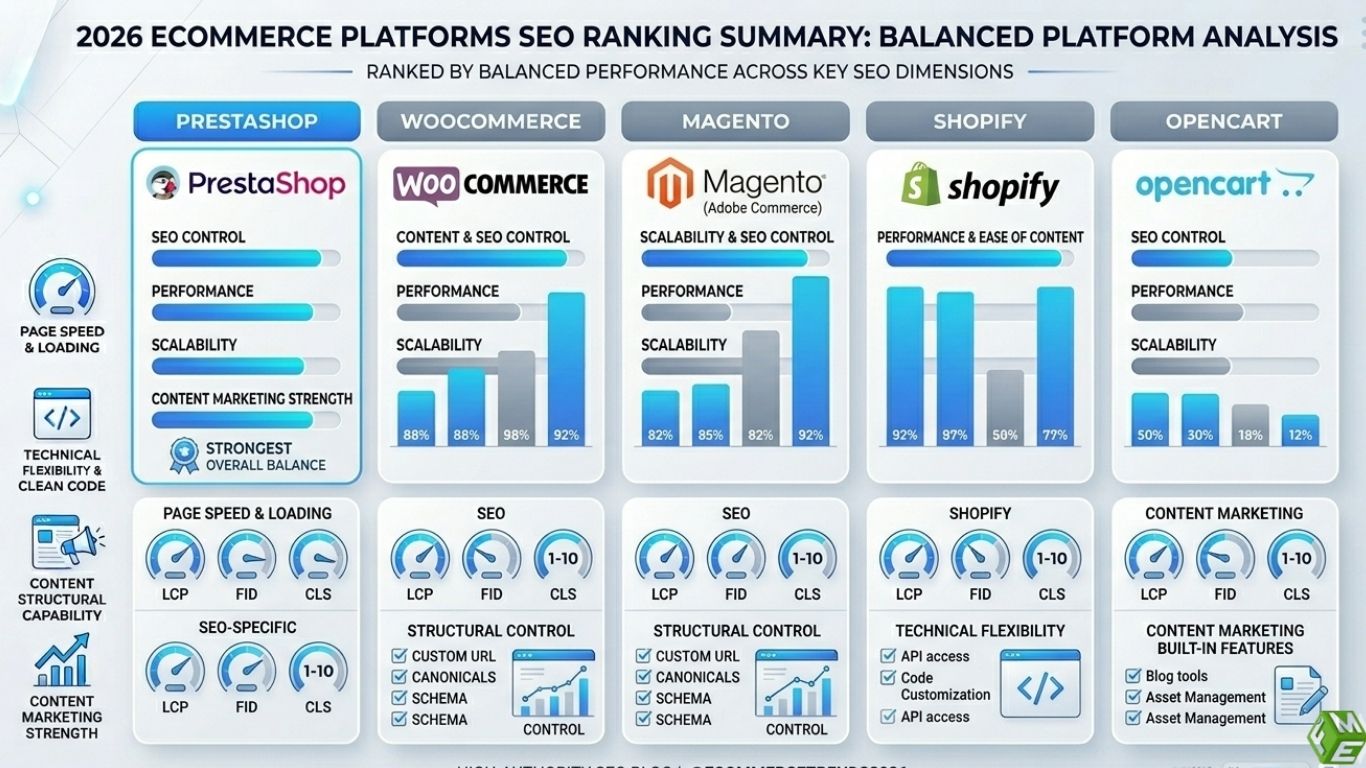
A pattern that becomes easily visible when you look at all major ecommerce platforms. Shopify is easy but restrictive. WooCommerce is flexible but maintenance-heavy. While magento is indeed powerful but a little bit complex. At an introductory level OpenCart is very light but does not offer venues for unparalleled SEO depth
But PrestaShop gives the best all-rounder choice. This includes advanced SEO control, competencies in performance output, scalable architecture and built-in features to eliminate over-reliance on a million plugins.
Final Verdict: Best Shopping Cart for SEO in 2026
Based on factors such as technical SEO control, performance optimization, and scalability, PrestaShop performs strongly as an all-round SEO-friendly ecommerce platform. However, the best choice still depends on business size, technical capability, and long-term growth strategy.
It offers the best combination of technical SEO control, performance optimization, and long-term scalability without unnecessary complexity. While other platforms excel in specific areas, none provide the same balanced SEO foundation as PrestaShop.
For this reason, PrestaShop is the clear winner as the best shopping cart for SEO in 2026.
