


PrestaShop merchants often wonder whether to rely on traditional checkout or use WhatsApp chat to improve conversions, especially as cart abandonment continues to rise. Choosing the right approach is important to guide customers toward completing their purchases.
The good news is that you don’t have to choose one over the other. Traditional checkout and WhatsApp each serve different purposes, and when combined, they create a more effective conversion strategy.
Two Conversion Methods in PrestaShop
-
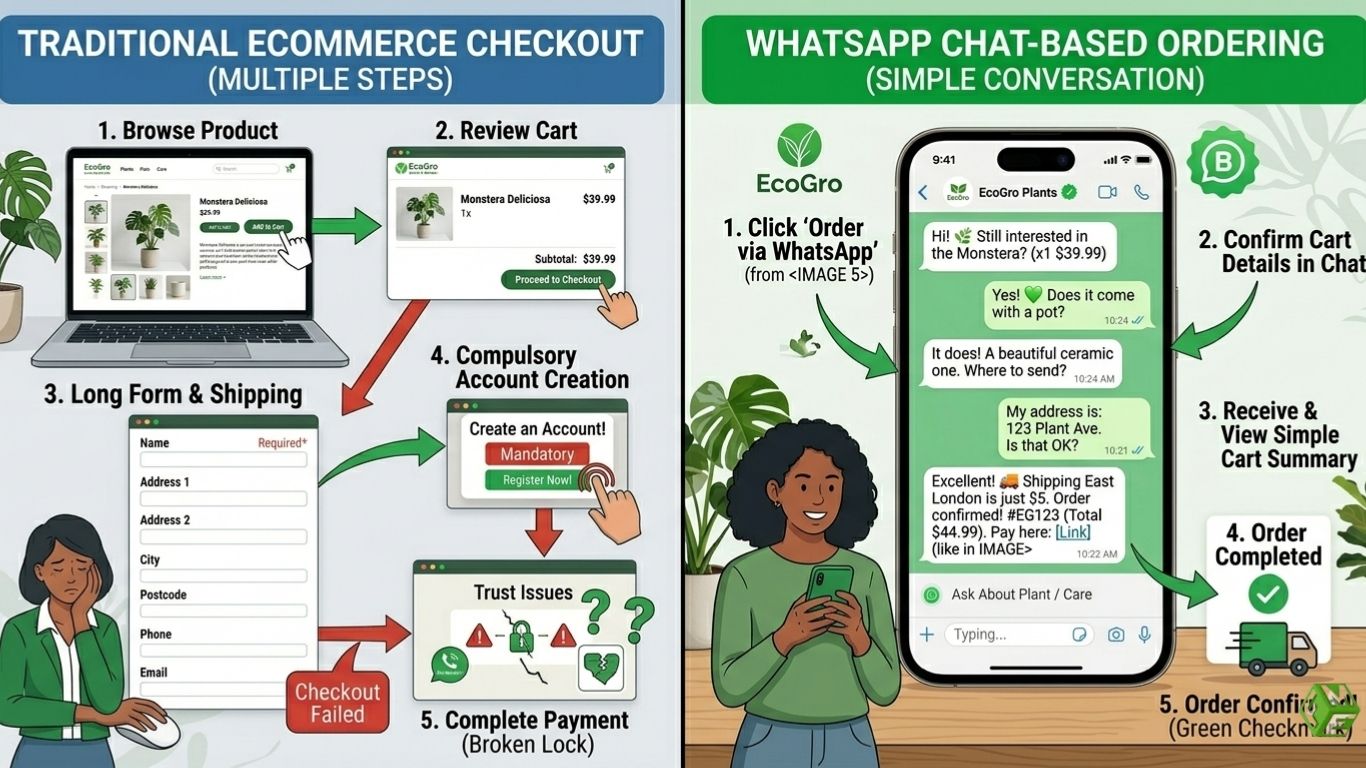
Standard PrestaShop Checkout Process
PrestaShop checkout follows a streamlined process:
Select Product → Check Out → Submit Information → Payment → Confirmation.
While checkout processes are designed for customer ease, they do introduce some friction, particularly the need to complete multiple customer information forms, account creation, and payment submission.
Checkout friction can occur due to:
- Long forms.
- Surprise shipping fees.
- Failed payment processing.
- Unavailable customer support.
Mobile checkout abandonment increases when friction occurs.
-
Ordering Through WhatsApp
Unlike traditional checkout, WhatsApp offers a chat-oriented purchasing process. The buyer communicates with the seller directly, which alters the purchasing experience.
Instead of navigating a complex checkout, users can:
- Ask questions.
- Confirm product details.
- Order through chat.
This establishes a human decision-making process that alleviates consumer sentiment, leading to quicker purchases. Customers can easily transition from questions to filling their shopping carts thanks to an optimized feedback loop. Thus, installing the innovative Prestashop WhatsApp Order and Chat Module on your store is the best bet.
Conversion Psychology: Why WhatsApp Chat Converts Differently
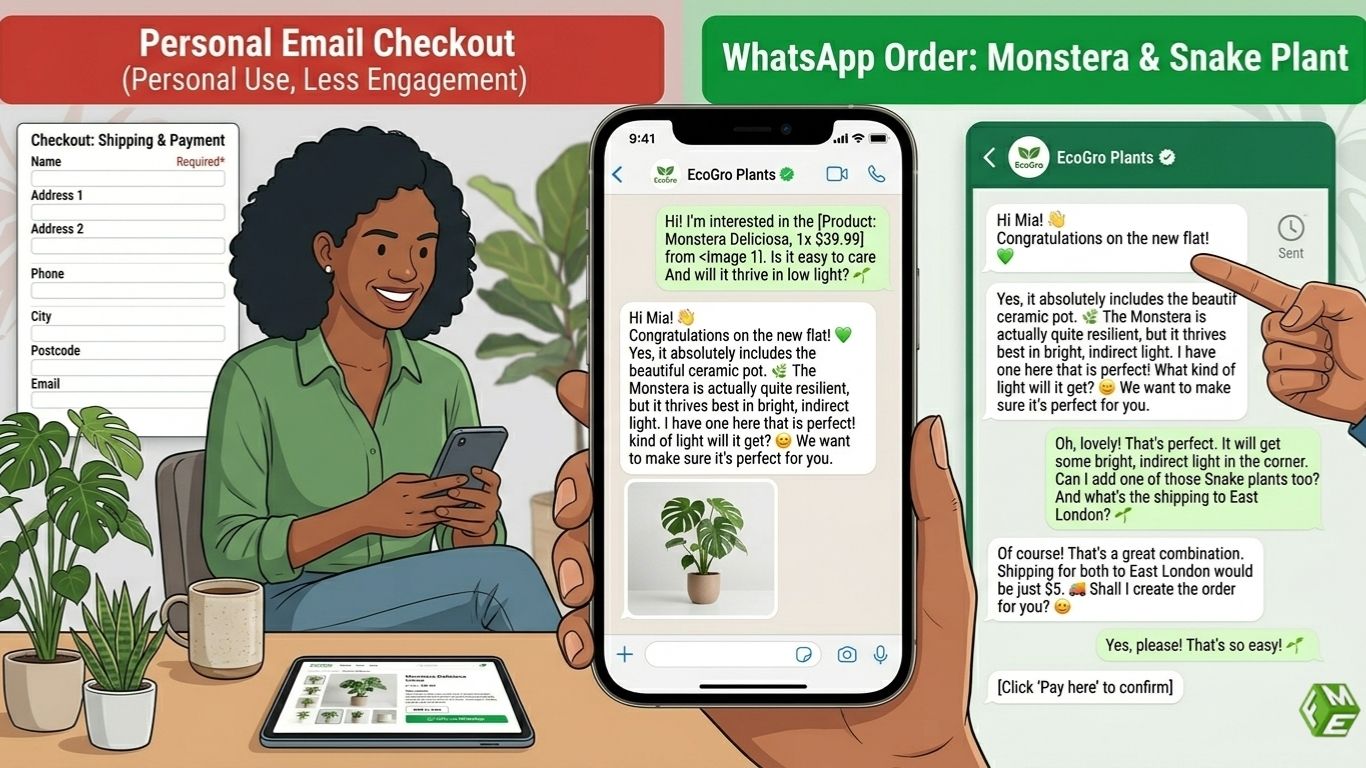
WhatsApp chat creates more conversions because it focuses on customers' needs, not the rigid steps of a checkout process.
To start, it creates trust and confidence. Customers feel more secure about their purchases because they can speak with someone. If a shopper is unsure about a product, they can get instant confirmation and instant contact, which closes the door on hesitancy.
Next, it lowers the cognitive load. With WhatsApp, rather than thinking about shipping, payment, and accounts commitments, customers just have to think about the conversation. It is a more streamlined process, which makes people more likely to pull the trigger on a purchase.
Immediate answers provided through WhatsApp keep customers engaged rather than forcing them to wait hours for an email reply.
Last, the conversation is social proof. Helpful, responsive communication creates trust and reliability, which encourages customers to buy from the store.
WhatsApp Chat vs Checkout: Feature-by-Feature Comparison
|
Feature |
Whatsapp Chat |
Traditional Checkout |
|
Conversion speed |
Fast (real-time interaction) |
Slower (multi-step process) |
|
Cart abandonment risk |
Low |
High |
|
Mobile usability |
Excellent |
Moderate |
|
Customer confidence |
High (Human interaction) |
Medium |
|
Payment flexibility |
High |
Limited to integrated methods |
|
Support involvement |
built-in |
Separte |
WhatsApp order processing leads in engagement and adaptability, whereas checkout solutions place an emphasis on automation and growth potential.
When Traditional Checkout Outperforms WhatsApp
Traditional checkout is more advantageous when the scenario is more organized and frictionless, such as:
- Quick checkout by recurring customers.
- Automated payment with Digital Product sales.
- Automated payment flows with credit card, PayPal, and subscription customers.
- Standardized payment systems for International Transactions.
In these instances, the presence of buyer's remorse is less of an obstacle.
WhatsApp Chat + Checkout
The best approach is clearly a hybrid approach.
WhatsApp can serve as post-checkout engagement to clarify and reassure.
Checkout can serve as the post-confirmation to clarify streamlining order workflows.
Abandoned carts can be retrieved through WhatsApp messages.
Implement a hybrid conversion funnel allowing users to communicate and checkout in whichever order they prefer.
For Example,
Customer inquires about a product on WhatsApp -> Confirmation is given -> Payment is completed via checkout link.
Giving users the ability to checkout at any time and ask questions/confirm orders creates a great user experience and helps maximize conversions.
Real World Examples & Conversion Potential
- Fashion Store: Customers confirm sizes via WhatsApp and order new stock suggested by the customer -> fewer returns.
- Electronics Store: Customers ask about a specification via WhatsApp -> more confident -> purchase is done way faster.
- Local Delivery Shop: Customers place orders via WhatsApp and set COD deliveries on the spot.
- Wholesale: Customers negotiate orders via WhatsApp chat -> more streamlined B2B sales.
All these successful cases show how WhatsApp engages with and caters to different industries by boosting conversion rates.
