


Ecommerce is evolving rapidly, and PrestaShop developers need to stay updated with the latest tools, technologies, and best practices. A skilled developer ensures your store is fast, secure, and fully optimized for modern online shopping experiences.
In this post, we’ll explore the essential skills and technical stack every PrestaShop developer should master in 2026 to build scalable, high-performing, and feature-rich online stores.
Core Technical PrestaShop Developer Skills
PHP Expertise (PrestaShop PHP developer skills)
PrestaShop is powered by PHP code. The developer cannot build and customize modules without PHP programming skills. It’s the primary skill that Prestashop store owners would want to hire a Prestashop developer for.
Why it matters:
- The core functionality of PrestaShop itself is written in PHP.
- PHP is used by developers to develop custom modules, increase features and fix bugs.
- Maintaining a well-structured and optimized PHP codebase helps your store run fast, secure, and easier to maintain.
Important skills that a developer should possess:
- Modular and reusable code through object-oriented programming.
- Debugging and problem-solving PHP issues.
- Optimise PHP scripts, if needed, for the store's performance.
MySQL & Database Management
Databases are the backbone of PrestaShop stores; this is where you manage products, customers and orders. Thus, for the custom Prestashop developer, MySQL expertise is critical.
Why it matters:
- When the database is efficiently designed, pages load fast, and errors are less frequent.
- Optimized queries have to be written by developers for product searches, filtering, and reporting.
- This is also a time-consuming, data-intensive task that involves changing records and ensuring some data integrity between different migration stages.
What skilled developers do:
- Normalize Databases to Minimize Redundancy.
- Query Optimization for Product Catalogs.
- Data migrations without loss or corruption.
- Creating new addons using prestashop module developer competencies.
Symfony Framework Knowledge
From version 8+, PrestaShop is based on the Symfony framework and uses MVC (Model-View-Controller) architecture. Symfony is the core of all contemporary module and feature development.
Why it matters:
- Symfony gives you a maintainable way to build features.
- It enables developers to extend the core PrestaShop functionality without disrupting the system.
- It helps to build efficient, scalable and reusable modules.
The main objectives developers achieve with Symfony:
- Creating controllers and entitites and services for custom features.
- Integrating modules into PrestaShop’s core precisely.
- Learning different design patterns to create better maintainable code.
PrestaShop Frontend Developer Skills
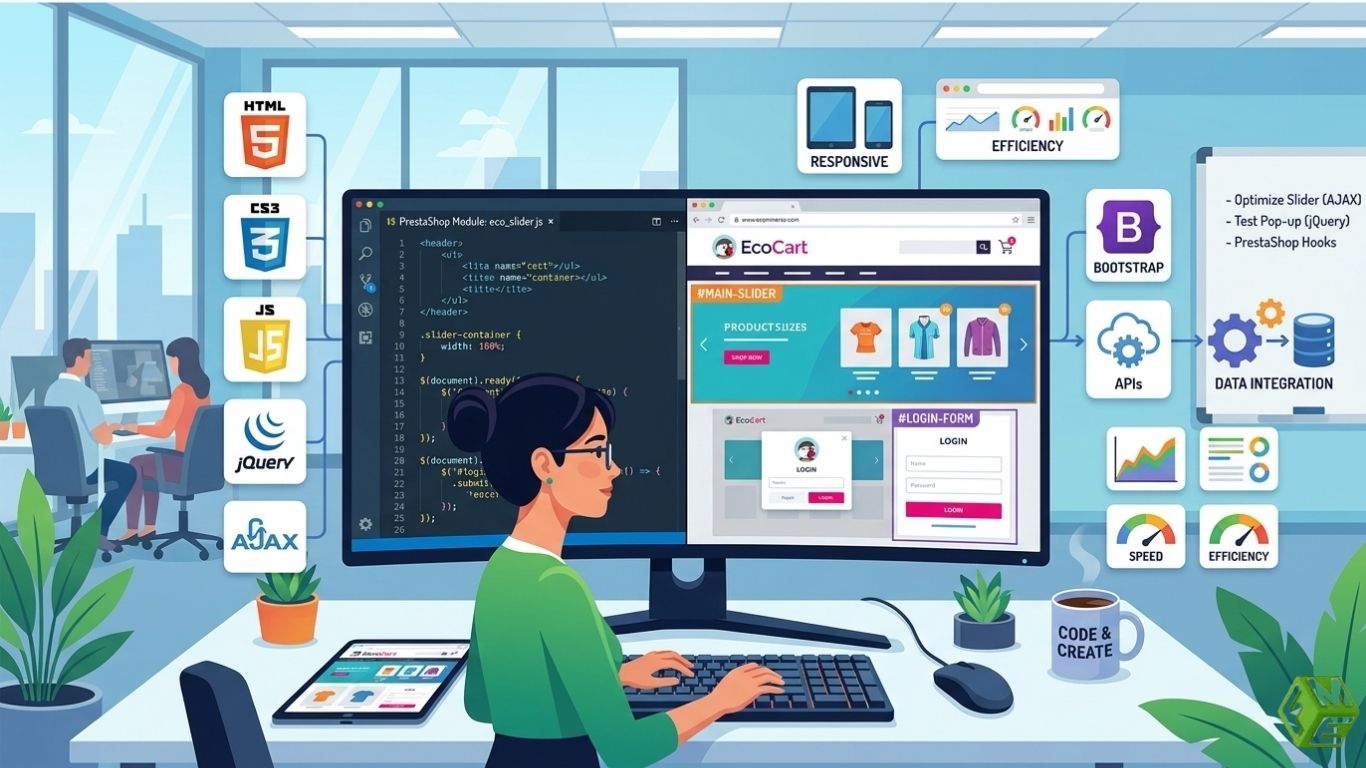
PrestaShop ensures backend operations, but you rely on frontend development for user experience. Developers need to make sure stores look good and act fast.
Why it matters:
A responsive and fast- loading site leads to more conversions.
(Between 60% to 80% of carts get abandoned. Good UX lowers cart abandonment rate and improves customer satisfaction.)
Key prestashop developer skills:
- HTML5 & CSS3: Developers must be able to give structure to the pages and style them with the best layouts suited for mobile.
- JavaScript, jQuery and AJAX: Create interactive features like sliders, pop-ups and forms with real-time validation.
- Bootstrap or other frameworks: Speed up development of responsive themes.
API Integration
As connected services, modern eCommerce stores need to talk to other RESTful APIs. Developers must integrate these seamlessly.
Why it matters:
- Streamlining basic functions such as payment processing and shipping.
- Improves efficiency and reduces errors.
- Improves customer shopping experience in general.
Developers should have:
- RESTful and SOAP API knowledge.
- The possibility of mapping data between PrestaShop and 3rd party systems.
- Persisting external connections in a safe and sound way.
Contemporary Skills for PrestaShop Developers
Performance Optimization
Speed is key for online stores as slow stores lose sales. Here are some techniques most developers use to speed up the PrestaShop sites:
- Caching using Redis or Varnish.
- Images and scripts compression and optimization.
- Database queries optimization and unnecessary data cleaning.
- Peeking under the hood at server and page performance for bottlenecks.
SEO & Digital Marketing Awareness
If customers can’t find a store, it’s useless. Developers need to get a grip on SEO basics and should always implement features that help with search rankings.
Key responsibilities:
- URLs, meta descriptions and product titles that are friendly to search engine optimization.
- Structured data (Schema markup) for better search visibility.
- Improved page speed to increase both user experience and PrestaShop SEO.
Security Best Practices
PrestaShop stores deal with sensitive customers’ data. Thus, Developers must prioritize security.
Critical tasks include:
- Writing secure, clean code to avoid vulnerabilities.
- Application of SSL and HTTPS for secure transactions.
- Avoiding SQL injection, Cross-site scripting and XSS.
- Keeping your PrestaShop core, themes and modules updated regularly.
Version Control & Collaboration
Version Management in Team-Based Development
Why it matters:
- Keeps a directory of code changes for debugging.
- Supports continuous integration and deployment.
Here are some PrestaShop development tools (cluster 4) developers mostly use:
- Git for version control.
- Repositorio Management: GitHub or GitLab.
- Automatically testing and deploying with CI/CD pipelines.
Progressive Web Apps (PWA) & Headless Commerce
With increasingly sophisticated and future-facing stores, PWAs and headless architecture are key.
Why it matters:
- PWAs allow apps to run inside browsers with a better experience.
- They separate the Frontend and Backend for Better Flexibility.
- Enables faster updates and omnichannel experiences.
PrestaShop developer required skills:
- Experience modern JavaScript frameworks like Vue. js or React.
- Have proven experience with PrestaShop APIs for headless setups.
- Knowledge of offline persistence, push notifications, and app-like performance.
Soft Skills That Every PrestaShop Developer Should Possess
A good developer should possess soft skills along with technical skills, such as:
- Problem Solving & Analytical Thinking: Timely debugging and resolution.
- Be Detail-Oriented: Have all modules, themes and integrations working perfectly.
- Communication & Collaboration: Collaborate effectively with designers, marketers, and business teams.
- Flexibility: Stay current with PrestaShop updates, new technologies, and trends.
Take Away
In 2026, being a PrestaShop developer goes beyond just PHP coding or module installation. Developers need a comprehensive skill set covering backend, frontend, integrations, performance, security, and modern eCommerce trends like PWAs and headless commerce.
Hiring a developer with this technical stack ensures your PrestaShop store is future-ready, secure, scalable, and optimized for both business growth and a seamless customer experience.
